
Blockchain technology has been hailed as a disruptive force to the finance sector, especially due to the functions of payments, security, transparency, investing, eligibility, opportunity and so on.
It is safe to say that banks and blockchains are quite different.
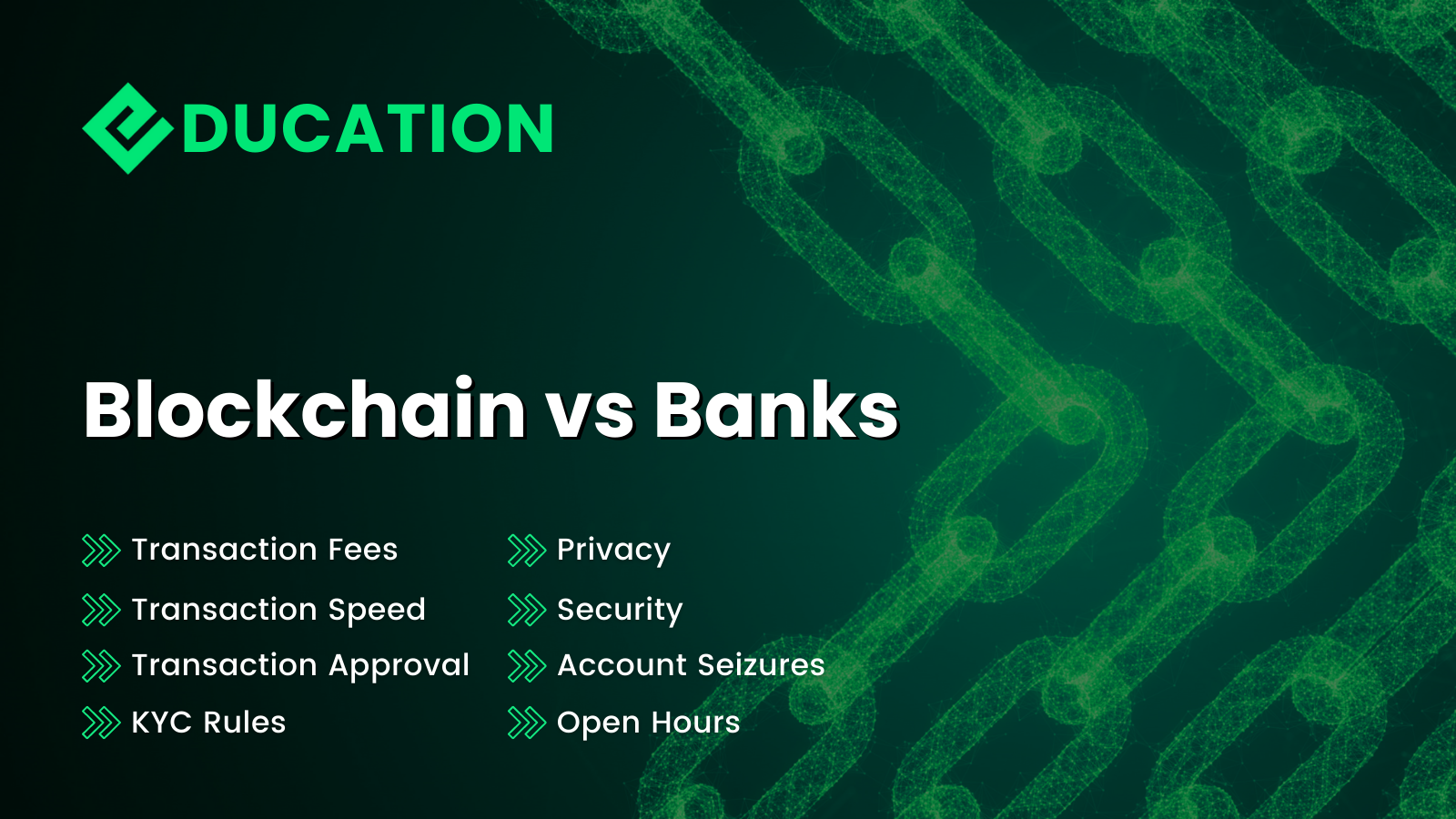
To provide an accurate idea, we will compare the main traits that characterize traditional financial institutions and cryptocurrencies.
How do we analyze Blockchain vs Banks
To make things as objective as possible, we gathered several relevant metrics that are relevant to the key attributes related to the financial domain.
As you will notice, we will constantly refer to cryptocurrencies to represent the features of blockchain technology.
Transaction Fees
Cryptos have variable transaction fees determined by miners and users. These fees can range between $0 and $100 (or even more), however, users can also determine how much of a fee they are willing to pay.
This creates an open marketplace where if the user sets their fee too low, their transaction may not be processed.
With banks on the other hand, we actually have a range of transaction fees, depending on how we transact:
- Card payments vary based on the card and is not paid by the user directly. Fees are paid to the payment processors by stores and are usually charged per transaction. The effect of this fee can sometimes make the costs of goods and services rise.
- Checks can cost between $1-$30 depending on banks.
- ACH transfers can cost up to $5 when sending to external accounts.
- Wire transfers can also cost up to $25, while international wire transfers can reach $50.
Transaction Speed
Transactions can take as little as seconds on a blockchain and as much as several hours, depending on network congestion.
With banks:
- Card payments take 24-48 hours.
- Checks payments take 24-72 hours.
- ACH transfers take 24-48 hours.
- Wire transfers can be completed within 24 hours, except for international, which can take up to 72 hours or more.
It is also important to highlight that bank transfers are typically not processed during weekends or holidays.
Transaction Approval
A Blockchain network itself does not dictate how an asset (cryptocurrency, NFT, etc) is used in any shape or form.
Users can transact Bitcoin, Ethereum or Energi how they see fit but should also adhere to the guidelines of their country or region.
Conversely, banks reserve the right to deny transactions for a variety of reasons.
Banks also reserve the right to freeze accounts. If your bank notices purchases in unusual locations or for unusual items, they can be denied.
Privacy
Blockchain assets, such as cryptos or NFTs, can be as private as the user wishes.
For instance, all Bitcoin is traceable, but it is impossible to establish who has ownership of Bitcoin if it was purchased anonymously.
Bank account information is stored on the bank’s private servers and held by the client.
Bank account privacy is limited to how secure the bank’s servers are and how well the individual user secures their own information.
If the bank’s servers were to be compromised, then the individual’s account would be as well.
Security
The larger the network grows, the more secure it gets. The level of security a Bitcoin or Energi holder has with their own crypto is entirely up to them.
For this reason, it is recommended that people use cold storage for larger quantities of BTC, NRG or any crypto amount that is intended to be held for a long period of time.
A bank account’s information is only as secure as the bank’s server that contains client account information.
This is true even when clients practice solid internet security measures like using secure passwords or two-factor authentication.
Account Seizures
If Crypto is used anonymously, governments would have a hard time tracking it down to seize it.
On the flipside, due to Know Your Customer regulation, governments can easily track people’s bank accounts and seize the assets within them for a variety of reasons.
KYC Rules
Anyone or anything can participate in Bitcoin’s or Energi’s networks with no identification, due to their Decentralized nature.
Although, when users join a Centralized Exchanges (CEX) such as Coinbase or Binance, they typically have to undergo KYC processes to have access to certain financial instruments, due to local, national and even international regulations.
On Energiswap, however, users can trade anonymously on the safest decentralized exchange (DEX) in the world.
KYC rules are a legal requirement that banks must fulfil in regards to their customers. This means it is legally required for banks to record a customer’s identification prior to opening an account. Bank accounts and other banking products require “Know Your Customer” (KYC) procedures.
Sign up to our Newsletter
Be sure to follow us on Twitter and Telegram for the latest Energi News, and join our vibrant Discord channels to connect with others, learn more about the world of Crypto & NFTs and be part of the Energi Community.